Final Year Project
Project Overview:
Aquanomalies is a cosy 3D side-scrolling fishing prototype where you capture mutated fish to earn cash and upgrade your gear to explore the depths to catch bigger and dangerous monsters. Display your catches and manage a highly customisable cosy Aquarium! A polished vertical slice to showcase the core game mechanic.
Contributions:
As the Game and Level Designer, I was tasked to ensure that the team's core vision, mechanics, and features were brought to life by ensuring that the scope of the game is feasible within our given timeframe and abilities.
Defining the “cosy” experience
I helped to define the moment-to-moment flow: approach fish → vacuum capture → short skill check → reward. I suggested keeping actions low-friction (quick retries, short downtime) so players feel calm instead of punished. This helped the game feel consistent and approachable from the first minute.
I provided useful design feedback and input which helped to shape the game experience. Throughout development design problems would also arise where I had to provide useful feedback and input, putting a heavy emphasis on the necessity of a feature. If the proposed idea/features do not serve a gameplay purpose or do not help to improve the player experience, they would not be implemented and I would propose suggestions or work arounds for them.
Designed levels around clarity, pacing, and progression
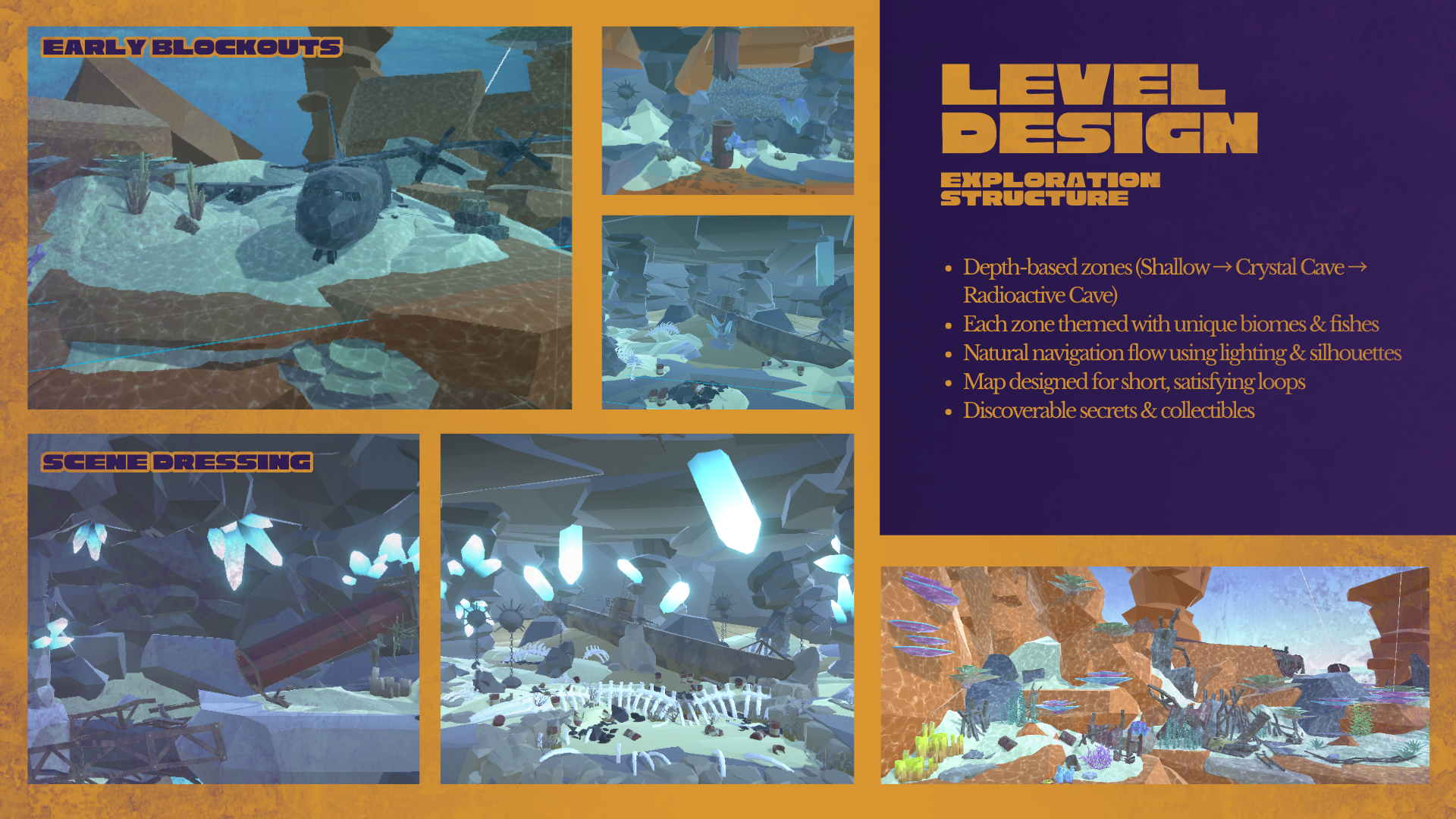
I blocked-out fish spawn locations and routes to control difficulty ramping. For example, safer early areas contains abundant and slower fish, then later areas with tighter terrain and more active (quicker) fish. Each area were play-tested multiple times to ensure that the colliders and entities were in working order. Each area was dressed up with assets to help make each area feel interesting and awesome to swim in.
Improved player feedback during catching so it feels satisfying
I pushed for clearer feedback when the player succeeds or fails the catch: strong visual cues (distinct colour flashes that match success states), camera emphasis (zoom/vignette style focus), and simple UI messaging. These changes made the minigame easier to understand and made “getting a fish” feel rewarding.
Takeaways:
Scope control and workload management
I learned to prioritise functionality over features and focus on what makes the game playable and fun. The main focus of the project was to deliver a polished yet optimised vertical slice featuring our core game mechanics. Working with friends allowed me to understand our strengths and weaknesses and has taught me to be smart and creative with my solutions. This improved my confidence in planning and made my work more realistic for student timelines.
The Iterative Process
I overcame the habit of tuning purely by intuition. By watching how people played and by playing through similar or inspired games, I adjusted pacing and catch difficulty so it stays fair and cosy. This made me more comfortable with iteration and less defensive about changing my designs.
Importance of clear communication
During discussions, we would often get carried away with many cool or interesting ideas that sound good on paper but might not work very well when implemented. I learned to translate them into simple, buildable tasks (what the player sees, what triggers, what counts as success, how it scales) to reveal design nuances and help the team to see how we can better implement them or find alternatives for potential problems. This improved collaboration and reduced misunderstandings, and it made me a more practical designer who can bridge vision and production.
Post a comment